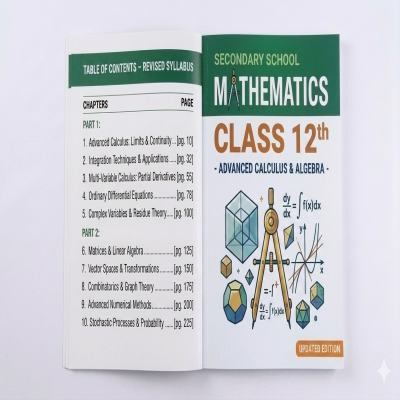
MODULE 1: Foundations of Mapping – Relations & FunctionsUnit 1.1: Core Concepts & Structural MappingTheoretical breakdown of mathematical relations.Visualizing mappings and ordered pairs.Unit 1.2: Classifications of RelationsReflexive, Symmetric, and Transitive properties.Mastering Equivalence Relations and equivalence classes.Unit 1.3: Advanced Functional ArchitectureOne-to-One (Injective) and Onto (Surjective) functions.Understanding Bijective mappings with coordinate graphs.Unit 1.4: Composite Systems & InvertibilityOperations on functions: Finding \(f \circ g(x)\) and \(g \circ f(x)\).Mathematical criteria for functional invertibility.🏋️ Practice Worksheets & Exercise Suites:Diagnostic Exercise 1.1: Identifying relation types in coordinate geometry.Skill Builder 1.2: Algebraic proofs for Injective and Surjective functions.Mastery Challenge 1.3: Real-world modeling using composite functions.MODULE 2: Circular Functions – Inverse TrigonometryUnit 2.1: Geometric Boundaries & RestrictionsWhy trigonometric functions fail global invertibility.Restricting domains to create well-defined inverse mappings.Unit 2.2: Principal Values & Coordinate QuadrantsDefining the Principal Value Branches for \(\sin^{-1}x\), \(\cos^{-1}x\), \(\tan^{-1}x\), etc.Graphic evaluations of inverse trigonometric functions.Unit 2.3: Operational Identities & Formula FrameworksSimplification techniques for complex trigonometric expressions.Substitution methods to solve advanced calculus problems later.🏋️ Practice Worksheets & Exercise Suites:Diagnostic Exercise 2.1: Rapid-fire extraction of principal values.Skill Builder 2.2: Simplifying algebraic expressions using inverse trig identities.Mastery Challenge 2.3: Multi-step trigonometric proof systems.MODULE 3: Linear Systems – Matrix AlgebraUnit 3.1: Data Arrays & Spatial DimensionsIntroduction to matrices as compact data storage structures.Understanding rows, columns, order, and addressing elements.Unit 3.2: Structural Taxonomies of MatricesRow, Column, Square, Diagonal, Scalar, and Identity matrices.Zero matrices and the definition of matrix equality.Unit 3.3: Matrix Arithmetic & Rules of EngagementScalar multiplication, matrix addition, and subtraction rules.The mechanics of matrix multiplication (row-by-column method).Unit 3.4: Array Transformations & The TransposeFlipping dimensions: Properties of the transpose operator.Unit 3.5: Structural SymmetryDefining Symmetric and Skew-Symmetric matrices.Decomposing any square matrix into symmetric and skew-symmetric components.Unit 3.6: Matrix Inversion StrategiesThe concept of elementary row and column operations.Deriving the inverse matrix using linear transformations.🏋️ Practice Worksheets & Exercise Suites:Diagnostic Exercise 3.1: Matrix multiplication constraints and dimension matching.Skill Builder 3.2: Computing matrix polynomials and equations.Mastery Challenge 3.3: Finding inverses using systematic elementary operations.MODULE 4: Advanced Matrix Metrics – DeterminantsUnit 4.1: Scalar Scaling of Square MatricesFundamental definition of a determinant for \(2\times2\) and \(3\times3\) arrays.Unit 4.2: Geometric DeterminationsCalculating the area of polygons and triangles on a Cartesian plane using determinants.Conditions for the collinearity of three distinct points.Unit 4.3: Internal Metrics – Minors & CofactorsIsolating sub-matrices: Calculating minors for individual elements.Applying sign grids to generate cofactor matrices.Unit 4.4: Adjugate Architecture & Algebraic InversesProperties of the Adjoint (Adjugate) matrix.The algebraic formula for matrix inversion: \(A^{-1} = \frac{1}{\vert{}A\vert{}} \text{adj}(A)\).Unit 4.5: Resolving Systems of Linear EquationsTesting systems for consistency and inconsistency.Solving systems of linear equations using Matrix Method (\(X = A^{-1}B\)).🏋️ Practice Worksheets & Exercise Suites:Diagnostic Exercise 4.1: Evaluating \(3\times3\) determinants efficiently.Skill Builder 4.2: Area calculations and verifying point linearity.Mastery Challenge 4.3: Solving three-variable real-world systems for market analysis.MODULE 5: Differential Calculus – Continuity & DifferentiabilityUnit 5.1: Mathematical Seamlessness & LimitsFormal definition of continuity at a point and over an interval.Left-hand limits, right-hand limits, and treating points of discontinuity.Unit 5.2: The Mechanics of DifferentiabilityThe geometric meaning of a derivative as a tangent slope.The relationship between continuity and differentiability.Unit 5.3: Transcendent Derivatives – Exponents & LogsDifferentiating exponential (\(e^x, a^x\)) and logarithmic (\(\ln x\)) functions.Unit 5.4: Logarithmic Differentiation StrategiesHandling complex products, quotients, and variable-to-the-power-of-variable equations (\(u^{v}\)).Unit 5.5: Parametric Coordinate SystemsFinding derivatives when \(x\) and \(y\) are defined by an independent third variable (\(t\) or \(\theta \)).Unit 5.6: Higher-Order Rates of ChangeThe physics of acceleration: Computing second-order derivatives (\(d^2y/dx^2\)).🏋️ Practice Worksheets & Exercise Suites:Diagnostic Exercise 5.1: Finding unknown constants to make a function continuous.Skill Builder 5.2: Chain rule applications on nested inverse trig and log functions.Mastery Challenge 5.3: High-order implicit and parametric differentiation proofs.MODULE 6: Real-World Calculus – Application of DerivativesUnit 6.1: Dynamic Rates of ChangeHow quantities change relative to time, volume, and distance.Unit 6.2: Monotonic Behavior of FunctionsUsing the first derivative to find intervals where a function strictly increases or decreases.Unit 6.3: Architectural Optimization – Maxima & MinimaLocal and absolute extrema on closed and open intervals.First and Second Derivative Tests for optimization.Solving maximum volume, minimum surface area, and profit optimization problems.🏋️ Practice Worksheets & Exercise Suites:Diagnostic Exercise 6.1: Rate calculations for expanding geometric shapes (spheres, cones).Skill Builder 6.2: Interval mapping for monotonic trends.Mastery Challenge 6.3: Applied business and engineering optimization word problems.MODULE 7: Advanced Research AppendicesAppendix A: Formal Proof Structures in Higher MathematicsDeductive vs. inductive reasoning methodologies.Appendix B: Applied Mathematical ModelingHow to convert complex real-world challenges into solvable mathematical frameworks.Comprehensive Verified Answers & Step-by-Step Solutions💡 How to turn this into your Course PDF:Highlight and copy all the text in the box above.Open your preferred word processor (like Microsoft Word, Google Docs, or Pages).Paste the text, add your custom course branding/logo at the top, and format the fonts to match your brand style.Click File > Save As / Export and choose PDF Document (.pdf).To help you build out this course, let me know if you would like me to generate the exact text content for a lecture or write out a complete, fully-solved 10-question practice test for any of these modules!HOW MUCH HOURS USING FOR COMPLETE ABOVE COURSETo complete this comprehensive course effectively for commercial or academic purposes, it will take approximately 120 to 140 hours of total student engagement.If you are structuring this as an online course for sale, this translates to roughly 45 to 50 hours of high-quality video lecture content, with the remaining hours dedicated to student practice, assignments, and mock tests.Here is the recommended breakdown per module to help you build your course timeline:⏱️ Course Hour Breakdown per ModuleModule NameVideo Lectures (Hours)Student Practice / Homework (Hours)Total Student HoursModule 1: Relations & Functions6 hours8 hours14 hoursModule 2: Inverse Trigonometry5 hours6 hours11 hoursModule 3: Matrices7 hours10 hours17 hoursModule 4: Determinants8 hours12 hours20 hoursModule 5: Continuity & Differentiability12 hours20 hours32 hoursModule 6: Application of Derivatives10 hours18 hours28 hoursModule 7: Appendices & Mock Exams2 hours6 hours8 hours🏆 TOTAL ESTIMATED TIME50 Hours80 Hours130 Hours